Reverse-Engineering AI Answers: What Brands Can Learn From Prompt Analysis
Marketing teams are being asked a new question by leadership.
“What is our AI strategy?”
It’s usually asked with a raised eyebrow, a vague sense of urgency, and very little clarity on what success looks like.
The important thing to understand early is this.
AI answers aren’t random.
They’re built from repeated prompts, trusted sources, and how clearly a brand exists as an entity across the web. If you understand how those answers are formed, you can influence them. You don’t need to game the system. You do need to understand it though.
The search journey has changed
At BrightonSEO last year, one point landed harder than most.
AI-led discovery is replacing early-stage Google searches.
Travel was the clearest example. Usage of AI tools for inspiration and planning has climbed sharply, in some cases from around a third of users to the vast majority. The behaviour is familiar. Ask a broad question. Get a summary. Narrow the field. Only then click.
This changes the shape of the funnel.
There are fewer clicks, but the users who arrive are already decided on the category and often the shortlist.
AI answers now sit before traditional SEO traffic. They filter demand rather than capture it.
How AI builds an answer
It helps to keep this simple.
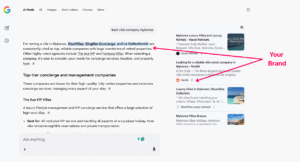
Large language models don’t rank pages. They synthesise information. Brands are treated as entities rather than URLs.
Those entities are understood through a mix of named entity recognition, knowledge graphs, and repeated citations across sources the model has learned to trust.
One analogy from the talk worked well.
Traditional search is a bookshelf.
AI is a human brain connecting concepts.
It isn’t asking which page is best. It’s asking which ideas belong together.
What prompt analysis actually is
Prompt analysis sounds technical. It isn’t.
At its core, it means looking at three things:
-
the questions users ask AI tools
-
the sources that appear in the answers
-
the brands that are mentioned repeatedly and in what context
For example:
“Best eSIMs for Europe”
“Luxury European holidays”
“Cheapest international roaming options”
Each prompt produces a different answer, built from different sources. Comparison guides surface in one. Editorial explainers in another. Community forums appear where lived experience matters.
AI consistently prefers content that explains, compares, and contextualises. Thin marketing pages rarely make the cut.
What brands can learn from prompt sources
When you analyse enough prompts, patterns emerge.
AI answers lean heavily on a familiar mix of sources:
-
trusted publishers like Forbes, the Guardian, the Wall Street Journal, and TechRadar
-
niche comparison and review sites
-
community forums, especially Reddit
-
encyclopaedic explainer content
One stat from the community mentions research stood out.
Reddit appears as a source across Google AI Overviews, Perplexity, and ChatGPT.
Not because it’s polished, but because it’s specific, opinionated, and grounded in real use cases. AI values that texture.
Why digital PR sits at the centre of AI visibility
This is where many strategies fall apart.
Links alone aren’t enough.
Mentions without context are forgettable.
One-off coverage fades quickly.
AI models learn through repetition and reinforcement. Brands become memorable when they’re explained clearly, cited often, and associated with specific ideas.
Data-led digital PR does this well. It feeds knowledge graphs. It creates consistent signals across authoritative sources. It gives AI something solid to work with.
Web mentions remain the single strongest factor. Not because of volume, but because of clarity.
AI remembers brands that explain, not brands that shout.
Reverse-engineering prompts into smarter PR
Prompt insights are most useful when they shape what you create next.
If AI answers in your category consistently cite affordability indexes, comparison tables, and expert commentary, then generic thought leadership won’t move the needle.
Original data will.
Prompt analysis can inform:
-
campaign ideas that match how users actually ask questions
-
data angles that align with AI-preferred sources
-
publication lists that already influence answers
-
spokesperson commentary that adds explanation, not noise
This isn’t about chasing prompts. It’s about understanding the language of demand.
Business outcomes, not vanity metrics
The uncomfortable truth is this.
You may not get the click.
What you get instead is consideration.
Prompt-led PR supports shortlist inclusion, brand recall, and assisted conversions. It reduces reliance on paid channels by shaping decisions before they reach a landing page.
For many brands, this is more valuable than a top-three ranking ever was.
How to measure success in 2026
Ranking reports tell a shrinking part of the story.
More useful signals include:
-
share of voice within AI answers
-
linked and unlinked brand mentions
-
growth in branded search demand
-
frequency of PR citations across trusted sources
-
assisted revenue influence
This is visibility reporting, not traditional SEO reporting. It reflects how people now discover and decide.
What brands should do next
There’s no need for a wholesale reinvention.
Start with a few priorities:
-
audit where AI sources its answers in your category
-
invest in authoritative, data-led digital PR
-
build consistent brand mentions across trusted publishers and communities
-
align SEO, PR, and GEO into a single visibility strategy
AI doesn’t reward novelty tactics. It rewards clarity, consistency, and authority.
That’s good news for brands willing to do the work properly.
