How to Check AI Visibility: A Step-by-Step Guide for Travel Brands

Someone is asking ChatGPT for the best safari company right now.
Or the best way to do the Inca Trail. Or which tour operator to book a Nile cruise with.
Either your brand is in that answer or a competitor’s is. There’s no page 2.
The problem is that most travel brands I speak to have no idea which one it is. They’re still checking keyword rankings while their customers have moved on to asking AI.
So here’s exactly what I’d do if I ran a travel business and wanted to know two things:
- How visible am I in AI search right now?
- What do I actually do about it?
First, a quick reality check on the data
Before anything else, it’s worth being honest about this.
There isn’t a tool on the market right now that gives you perfectly accurate AI visibility data. AI answers change by model, by day and by how the question is phrased.
So we treat all of this as directional.
It won’t tell you that you’re in “position 3” the way an SEO tool might. What it will tell you is where you’re showing up, where you’re not, who’s beating you and which sources are shaping the answers.
That’s more than enough to build a plan on.
The tool we use at Minty for this is Peec AI. There are plenty of AI visibility trackers out there, but it’s one of my favourites, so that’s what I’ll use for the walkthrough.
Step 1: Start with keywords, then turn them into prompts
Prompts are the foundation of all of this, so it’s worth getting them right.
We don’t start by guessing what people type into ChatGPT. We start with traditional keyword research.
Take a keyword like “best safari companies”. Check its search volume in a tool like Ahrefs or Google Keyword Planner, so you know it’s actually worth caring about.
Then fan it out into the questions your ideal customer would realistically ask an AI assistant. For example:
- Best safari companies for a first-time trip to Kenya
- Which safari operators are best for families with young kids?
- Luxury safari companies in Tanzania with private guides
- Is a good safari company?
- How much does a 10-day safari in Botswana cost?
Some of these are commercial (“who should I book with?”), some are informational (“how much does it cost?”), and some are about your brand directly. You want a mix.
Step 2: Group your prompts by topic
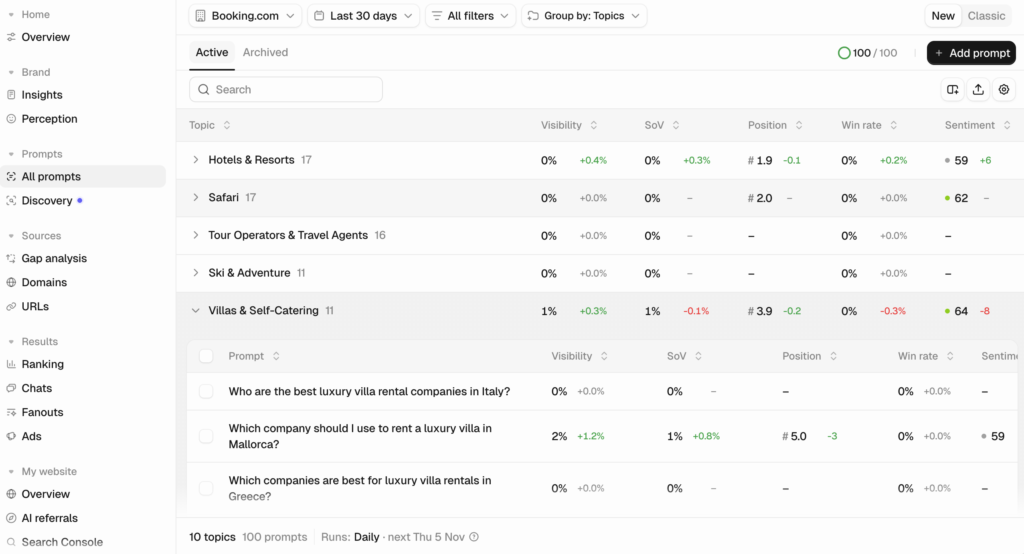
Once you’ve got your list, group the prompts into topics, such as destinations, trip types or audiences.
It sounds like admin, but it gives you a lot more control later. You’ll be able to see that you’re strong for “family safaris” but invisible for “luxury safaris”, rather than one blended number that hides the detail.
In the demo project in the video we’re tracking 100 prompts. For some of our clients, it runs into the thousands.
Step 3: Add your competitors (and all their nicknames)
Visibility on its own doesn’t mean much. You need to know how you compare.
Add the competitors you actually lose bookings to. Then add the variations of their names that might come up in an AI answer.
Travel is full of these. Abercrombie & Kent might be written as “A&K”, “A & K” or with “and” instead of the ampersand. If you don’t add the variations, you’ll undercount them.
Peec will also suggest competitors based on what’s showing up in the answers. Treat these as a guide. Some will be spot on, some won’t be relevant.
Step 4: Read your baseline
Once your prompts have run for a little while, you’ll have a baseline. The numbers I look at first are:
- Visibility: the percentage of AI answers that mention your brand
- Share of voice: your slice of all brand mentions across your prompts, compared with competitors
- Position: where you tend to appear when you are mentioned (lower is better)
- Sentiment: how positively you’re described, on a 0 to 100 scale
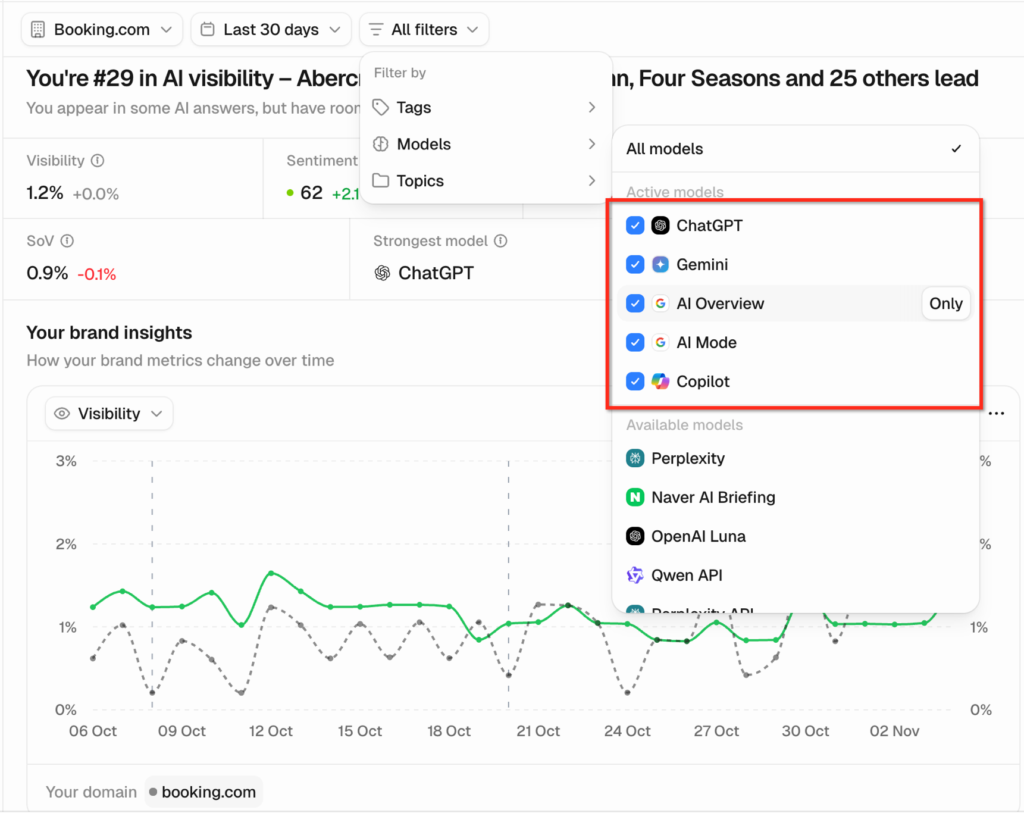
You can break these down by AI model, by topic and against each competitor. That’s usually where the interesting stuff is. A lot of travel brands find they’re doing fine in one model and barely exist in another.
Step 5: Find out which sources the AI trusts
This is the bit most people skip, and it’s the most useful part of the whole process.
AI assistants don’t make their recommendations up. They pull from sources. If you can see which sources are being used for your prompts, you know exactly where you need to show up.
In Peec, you can see every domain and URL being cited, and filter them by type, such as editorial, user-generated content or competitor sites.
What you’ll find is that travel looks very different from B2B or most other industries. The sources that matter for “best safari company” are not the sources that matter for “best accounting software”.
It tells you what to go after, and just as importantly, what not to bother with.
Step 6: Work out what to do with each source
Here’s how I’d approach the main source types for a travel brand.
YouTube
In our demo project, over 170 YouTube channels were being cited. That’s a lot of influence sitting in one place.
You can see exactly which videos are being referenced and whether your brand is mentioned in them. From there you’ve got two options.
Reach out to those creators for a feature, a review or a guest appearance. Or, if you’ve got the resource, build your own channel and campaigns to compete for those spots.
Competitor and blog content
Filter the cited URLs by type, such as how-to guides, and you’ll spot the content AI is leaning on for questions like “how to plan a Kilimanjaro climb”.
Some of it will be genuinely great. A lot of it won’t.
In the demo, one of the guides being cited was pretty thin. That’s an opportunity. Create something better, more detailed and more useful, optimise it properly, and you’ve got a real chance of replacing it as the source.
We’ve seen new pages picked up as sources within weeks, and sometimes within days.
Editorial and travel press
Filter by editorial and you’ll see the publications AI already trusts for your topics. For travel, think the likes of CNBC and Condé Nast Traveler.
This is Digital PR. Reach out to the journalists, get featured in existing articles where it makes sense, or pitch new stories that could take over those spots.
A mention on one of these does double duty. It sends strong authority signals to both traditional search engines and AI search.
Reddit and forums
Reddit isn’t being cited as heavily as it was earlier in the year, but it still shows up.
You can see which threads are surfacing and whether your brand is in them. If you’ve got a genuine presence on Reddit, answering real traveller questions helpfully is still worth doing.
Just don’t build your whole strategy around it. I’ve written about why here.
Review sites
For travel, review platforms like Tripadvisor, Trustpilot and Google reviews feed directly into how AI describes you. They shape sentiment as much as visibility, so volume and recency both matter.
Listicles
“Best tour operators for X” articles get cited a lot. The goal is to earn a place on credible ones.
What I wouldn’t do is publish your own “Top 10 Safari Companies” list with yourself at number one. AI assistants are already starting to flag these as conflicts of interest.
Your own website
If AI can’t work out what you offer, where you go and roughly what it costs, nobody else is going to fix that for you.
Clear trip pages, sample itineraries, pricing guidance, FAQs and original insight from people who’ve actually been there all help.
Step 7: Act, then track the movement
Once you’ve got a plan, start working through it and keep tracking the same prompts.
Because you set a baseline in Step 4, you’ll be able to see whether your visibility, share of voice and sentiment are moving, and which actions moved them.
As an example, we recently analysed which competitor content was being cited for a client’s most commercial prompts and created one better article. Within 30 days, it had been retrieved 15 times across the prompts we track and cited inline 9 times.
One page isn’t a case study. But it shows how direct the link between action and visibility can be.
What this looks like over the next few months
None of these tools are perfect yet, and I’d be wary of anyone who says otherwise.
But if you go into the next few months with:
- A benchmark of where your brand stands in AI search today
- A clear view of which competitors are beating you, and where
- A plan for which content, outreach and channels to focus on
You’ll be a long way ahead of the travel brands still debating which tool to use.
In our experience, if you consistently act on what you find, you should start seeing real movement over 3 to 6 months.
