The AI Search Correction Is Coming
Rumours are there’s a pretty big Google/AI Search update on the horizon.
I’m not going to pretend I know exactly what it looks like. Nobody does.
But I’ve been talking a lot about self-promotional listicles and other questionable AI Search tactics for a while now, and it looks like the platforms are finally starting to catch on.
Over 40% of citations were agencies ranking themselves #1
We recently ran some testing on searches like “best SEO agency”.
Over 40% of the sources cited by LLMs were self-promotional listicles.
You know the format. “The 15 Best SEO Agencies in London (2026)”. Written by an SEO agency in London.
All of who by complete coincidence have ranked themselves at number one.
It’s the easiest AI Search tactic going. Publish the list, get it indexed, wait for ChatGPT to pick it up.
And for a while, it’s worked really well.
Now LLMs are calling it out
One of the most interesting things about this is that LLMs are still citing these articles. But in some cases they’re now actively questioning them.
I asked Claude for the best SEO agencies and, before giving a single recommendation, it opened with a warning.
It flagged that most “best SEO agencies in London” lists are written by agencies ranking themselves at or near the top, and pointed to a specific example of an agency’s list that features the agency itself.
Then it explained what it was doing instead: leaning on industry awards that are judged externally and agencies that appear repeatedly across independent sources.
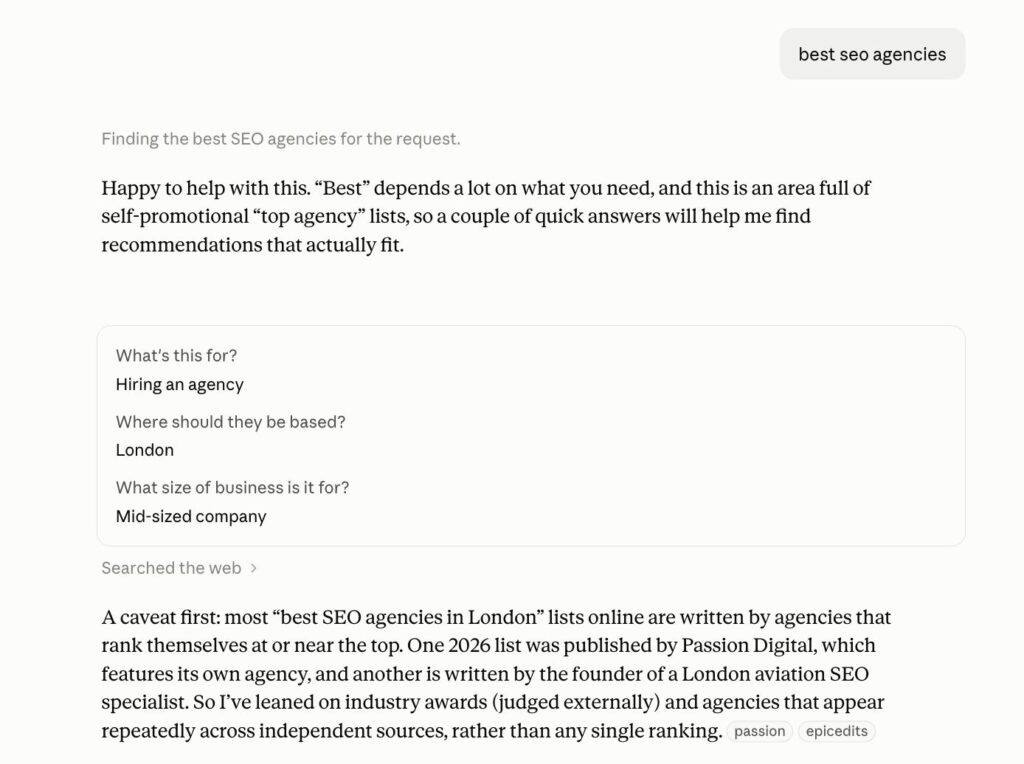
Claude flagging the conflict of interest in self-promotional listicles before making any recommendations
So the listicle still got cited.
It just got cited as an example of what not to trust. And the agency that wrote it was left out of the recommendations.
That’s a pretty bad outcome if that list was your AI Search strategy.
Anthropic has just changed the rules
On top of this, Anthropic has published a new version of Claude’s Usage Policy, which comes into effect on 12 November.
There’s a new section called Do Not Engage in Deceptive Campaigns or Artificial Activity, and one line in it is written specifically about search.
It prohibits using Claude to manipulate the sources that search engines and AI systems draw answers from, by seeding them with content that misrepresents where it came from, who wrote it, or how independent it really is.
In practice, that covers things like:
- Fake authors and personas
- Networks of supposedly independent websites that are actually connected
- Fake reviews and fake accounts
- Hiding who is really behind a piece of content
- Seeding multiple websites with the same claims to influence AI-generated answers
- Building the tools to do any of the above, or selling it as a service
As The SEO Handbook points out, the previous version of the policy didn’t mention search engines or AI answers at all. The old rules on spam and fake personas arguably covered most of this already. The new wording removes the argument.
And this isn’t theoretical as Anthropic’s September threat intelligence report traced one operation back to a France-based advertising agency running around 70 fake local news sites. The articles were signed by journalists who didn’t exist, nearly 9,000 were published, and part of the aim was to boost the sites’ authority in search.
Anthropic banned the account.
Google’s been heading this way for a while
None of this comes out of nowhere.
Google has been going after scaled content abuse and site reputation abuse through its spam policies since 2024. Mass-produced content, parasite SEO, sites renting out sections to third parties. All already in the firing line.
What’s new is an AI company explicitly naming the manipulation of AI answers.
What this is (and isn’t)
Two caveats, because I don’t want to overstate this.
First, this isn’t confirmation of an upcoming algorithm update. The rumours are still rumours.
Second, Anthropic’s policy isn’t a ranking change. It governs what people do with Claude, not how Claude picks or cites sources. Break it and you lose access to Claude. It doesn’t get your site de-cited.
But put it all together:
LLMs flagging conflicts of interest in real time. Google’s spam policies already targeting scaled and manufactured content. An AI company writing “don’t manipulate AI answers” into its rules.
The direction of travel seems pretty clear.
My prediction for the next 6 to 12 months
I think we’ll see a much bigger correction around:
- Self-promotional listicles
- Fake authors and invented bylines
- Manufactured citations
- Scaled GEO content designed purely to game AI Search
A lot of this reminds me of the early days of SEO.
Exact match domains. Article spinning. Link networks.
Every one of them worked brilliantly. Right up until the algorithms caught up.
So what should you actually do?
Same thing I said in Reddit’s Dead. Now What?: stop looking for the next hack.
If you’ve published a “best X” list with yourself at #1, ask whether it would stand up if a model, or a buyer, read it with a sceptical eye.
Being upfront about who wrote it and including genuine competitors on merit is the bare minimum.
Then put the effort into the stuff that’s much harder to fake:
Independent third-party recommendations
Comparison pages, roundups and directories written by people who aren’t you.
Editorial coverage
Journalists and publications that AI platforms already trust and cite.
Recognition judged by someone else
Awards, accreditations, reviews from real clients. Quite literally what Claude said it was prioritising.
Your own website
Content that genuinely answers the questions people are asking, written by real people with real expertise, and structured so it can actually be retrieved and cited.
This is why I keep saying AI Search looks a lot more like SEO and Digital PR working together than some brand new discipline.
It’s less exciting than gaming a listicle.
But it’s also a lot harder for the next update to wipe out.
Let’s see where the next few months take us.
